2023 02 22 Ash Wednesday
Settle us into the Discomfort of Silence
[Isaiah 58:1-12; 2 Corinthians 5:20-6:10; Matthew 6:1-6, 16-21]

Cape Town, South Africa
 //
//2023 02 22 Ash Wednesday
Settle us into the Discomfort of Silence
[Isaiah 58:1-12; 2 Corinthians 5:20-6:10; Matthew 6:1-6, 16-21]
//2023 02 19: Sunday Sermon
Alan Storey: Climbing the Mount of Contemplation
[Matthew 17:1-9]
Prayer for Peace, Hope and Justice by Ian Proudfoot.
//
Friends,
The 40 days of Lent begin this Ash Wednesday (22nd February). Lent is wilderness time – desert time. Having spent a week in the Karoo in 40 degree January-heat, I can tell you that desert time is slow-time. No one is rushing about in 40 degrees °C! Lent is slow-time. A time to withdraw from the noise and distractions that keep us detached from ourselves, others and life as a whole. It is time to go inward … so we can re-enter the world more deeply. It is time to seek out the shade of Silence, Solitude and Stillness and to deepen our practices of each.
In preparation for Lent I remind you again of the pattern of Archbishop Desmond Tutu’s daily life. A daily life punctuated with prayerful pause. Tall towers are dependent on deep foundations to keep standing. This was equally true for Tutu. His public life of prophetic action and courage was under-pinned by his private life of prayer and contemplation. His life was one of daily discipline. May his example inspire us to shape our own days with greater deliberateness to nurture our inner life so that our outer life may stretch to new heights of integrity, courage, wisdom, justice and mercy.
Here is a summary of Tutu’s daily practice:
04:00 – Personal prayers (weekdays)
05:00 – Fast 30 minute walk or slow jog
05:30 – Shower
06:00 – Devotional reading / reflection
07:30 – Recite formal Morning Prayer in chapel
08:00 – Daily Eucharist
08:30 – Breakfast (a glass of orange juice)
09:00 – Office work / appointments
11:00 – Tea break (again at 15:30)
11:00 – Office work / appointments
13:00 – Personal prayer
13:30 – Lunch and hour-long nap
15:00 – Office work / appointments
15:30 – Tea break
18:00 – Evening prayer in chapel
19:00 – A drink (usually a rum and coke) and supper at home
21:00 – In bed by 21:00 or 22:00
23:00 – Asleep (after Compline prayers)
“In addition to his daily prayers, Tutu fasted until supper on Fridays and observed a “quiet day” every month and a seven-day silent retreat once a year. During Lent he ate only in the evenings.”
It soon became apparent to the staff of Bishops-court that Tutu the ebullient extrovert and Tutu the meditative priest who needed six or seven hours a day in silence were two sides of the same coin. One could not exist without the other: in particular, his extraordinary capacity to communicate with warmth, compassion, and humour depended on the regeneration of personal resources, which in turn depended on the iron self-discipline of his prayers.”
[Summarised from: Rabble-Rouser for Peace – The Authorised Biography of Desmond Tutu. By: John Allen. Pages 174/5]
Grace,
Alan
PS:
Ash Wednesday Service at 7 p.m. on 22 February.
Manna and Mercy: 3-5 March at Rosebank Methodist Church and 5-7 May at Table View Methodist Church.
//2023 02 12 Sunday Sermon
Alan Storey: Sermon on the Mount: Take 3
[Deuteronomy 30:15-20; Matthew 5:21-37]
Opening Prayer by Alan Storey
//2023 02 05 Sunday Sermon
Alan Storey: Selfless Salt & Humble Light
[Matthew 5:13-20]
//
Friends,
Last week I quoted from Paul Tillich’s sermon entitled: You are Accepted. Richly dense and worth every hour of thoughtful reflection from the reader. He begins by admitting that: “There are few words more strange to most of us than “sin” and “grace.” … But there is a mysterious fact about the great words of our religious tradition: they cannot be replaced.”
Tillich then proceeds to dive into the depth of our human existence to rediscover the meaning of these two great words. Near the end of his sermon he describes what happens when grace strikes us. Seldom have I read words that provoke such longing:
We cannot transform our lives, unless we allow them to be transformed by that stroke of grace. It happens; or it does not happen. And certainly it does not happen if we try to force it upon ourselves, just as it shall not happen so long as we think, in our self-complacency, that we have no need of it.
Grace strikes us when we are in great pain and restlessness. It strikes us when we walk through the dark valley of a meaningless and empty life. It strikes us when we feel that our separation is deeper than usual, because we have violated another life, a life which we loved, or from which we were estranged. It strikes us when our disgust for our own being, our indifference, our weakness, our hostility, and our lack of direction and composure have become intolerable to us. It strikes us when, year after year, the longed-for perfection of life does not appear, when the old compulsions reign within us as they have for decades, when despair destroys all joy and courage.
Sometimes at that moment a wave of light breaks into our darkness, and it is as though a voice were saying: “You are accepted. You are accepted, accepted by that which is greater than you, and the name of which you do not know. Do not ask for the name now; perhaps you will find it later. Do not try to do anything now; perhaps later you will do much. Do not seek for anything; do not perform anything; do not intend anything. Simply accept the fact that you are accepted!” If that happens to us, we experience grace.
After such an experience we may not be better than before, and we may riot believe more than before. But everything is transformed. In that moment, grace conquers sin, and reconciliation bridges the gulf of estrangement. And nothing is demanded of this experience, no religious or moral or intellectual presupposition, nothing but acceptance.
In the light of this grace we perceive the power of grace in our relation to others … We experience the grace of being able to look frankly into the eyes of another, the miraculous grace of reunion of life with life. … We experience the grace which is able to overcome the tragic separation of the sexes, of the generations, of the nations, of the races, and even the utter strangeness between [humanity] and nature. Sometimes grace appears in all these separations to reunite us with those to whom we belong. For life belongs to life. … And in the light of this grace we perceive the power of grace in our relation to ourselves. … For it is such moments that make us love our life, that make us accept ourselves, not in our goodness and self-complacency, but in our certainty of the eternal meaning of our life. We cannot force ourselves to accept ourselves. … But sometimes it happens that we receive the power to say “yes” to ourselves, that peace enters into us and makes us whole, that self-hate and self-contempt disappear, and that our self is reunited with itself. Then we say that grace has come upon us.”
Grace is not just amazing. It’s radical and revolutionary. Political and personal in saving scope. Transforming relations between nations as well as transforming our inner most being. If these words also provoke a longing within you, may our longing be our prayer for grace to strike.
Grace,
Alan
//2023 01 29 Sunday Sermon
Alan Storey: Beatitude Covenant
[Micah 6:1-8; Matthew 5:1-12]
Prayer for Peace, Hope and Justice by Terence Parker.
//
Dear Friends,
This is my final year at CMM.
Methodist ministers are gifted with 5-year commitments in church community. I use the word “gifted” because strictly speaking Methodist ministers are not “employees” of the church. I have never signed a work contract and I would not have a legal leg to stand on at the CCMA. Instead of the church employing clergy, the church gifts clergy with an opportunity to live out their Gospel calling within a specific community of faith. A covenantal, rather than a contractual, relationship exists between Methodist ministers and the Methodist Church. On 26 November 2023 I will complete my third 5-year commitment at CMM. In other words, I will have received three times the normal GIFT! Capital letters don’t get close to the size of this GIFT, but I will use them in any case. I am so grateful for:
I remember when I arrived here, my mom said to me: “You have new people to love and new people to be loved by”. Mom’s summary of what it means to join and journey with a community is simple and beautiful. To love and be loved is how we become more fully human. Therefore, the greatest GIFT you have given me is the GIFT of deepening my humanity. I will leave CMM at the end of this year more human than when I arrived.
I don’t know what my future plans are yet, but I do have a desire to explore a different rhythm of life. A life with fewer words, especially weekly words. I look forward to exploring silence for a season and then wait and see…
We don’t know who will be replacing me yet. However, the process is underway. As always the Stationing Committee is faced with the challenge to align clergy availability and suitability with the local church and context. It is not an easy task and we offer prayerful hearts for those involved in this process.
As I write to tell you that this is my final year at CMM, I can’t think of a more appropriate day to be renewing our annual Covenant together. First prayed in 1755:
Beloved in Christ, let us once again claim for ourselves this Covenant which God has made with God’s people, and take upon us the yoke of Christ. To take Jesus’ yoke upon us means that we are content for him to appoint us our place and work, and himself to be our reward.
Christ has many services to be done: some are easy, others are difficult; some bring honour, others bring reproach; some are suitable to our natural inclinations and material interests, others are contrary to both; in some we may please Christ and please ourselves, in others we cannot please Christ except by denying ourselves. Yet the power to do all these things is given to us in Christ, who strengthens us.
Therefore let us make this Covenant of God our own. Let us give ourselves to God, trusting in God’s promises and relying on God’s grace.
Lord God, Holy Lord, since you have called us through Christ to share in this gracious Covenant, we take upon ourselves with joy the yoke of obedience and, for the love of you, engage ourselves to seek and do your perfect will.
We are no longer our own but yours. I am no longer my own, but yours. Put me to what you will, rank me with whom you will; put me to doing, put me to suffering*; let me be employed for you or laid aside for you, exalted for you or brought low for you; let me be full, let me be empty; let me have all things, let me have nothing; I fully and freely yield all things to your pleasure and disposal.
And now, glorious and blessed God, Creator, Redeemer and Sustainer, you are mine and I am yours. So be it. And the Covenant now made on earth, let it be ratified in heaven. Amen.
In grace,
Alan
*Please note: The traditional words, “Put me to doing, put me to suffering,” do not mean that we ask God to make us suffer. Rather, they express our desire to do any faithful act regardless of whether there is suffering involved.
//2023 01 22 Sunday Sermon
Alan Storey: Water into Wine: Resurrection
[John 2:1-11]
Opening Prayer by Joan Proudfoot
//
Friends,
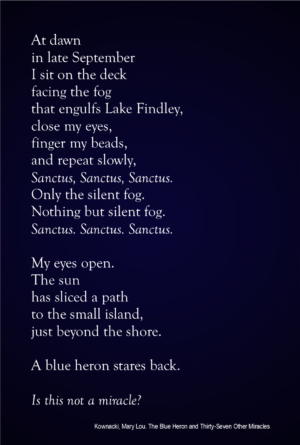
Last week I shared with you Mary Lou Kownacki’s description of the Benedictine way of Christian life – from her book: Peace is our Calling: Contemporary Monasticism and the Peace Movement. This week I share some of the multitudes of miracles she witnessed through her attentively observant wonder-filled living. I pray that as we see how she sees – we may begin to see as she sees:
From the introduction of her book The Blue Heron and Thirty-Seven Other Miracles, Kownacki writes:
“The real miracle is not to walk either on water or in thin air, but to walk on the earth,” Thich Nhat Hanh, the Buddhist monk wrote.
But who believes him?
This is a book about trying to walk on earth, about taking steps to see every moment as a miracle, as a blessing, as a love song from our Creator. The book is also an invitation, an encouragement to find the miraculous in the ordinary events of your life. Try to imagine how different life would be if we all recognised and revelled in the present, in the common, as sacrament. Come, let’s walk together on earth. Let’s celebrate the miracles happening to us moment by moment.
Monday morning
in the inner city.
My guru,
the boom box
on the neighbor’s tenement
roof,
about five yards from my
prayer corner.
This morning
I am offered
a choice of mantras:
“Born in the USA”
or
“Like a Rolling Stone.”
Koans to wrestle with a
lifetime
from Zen masters
Bruce Springsteen and Bob Dylan.
Is this not a miracle?
She is still weeping
for the young deer
whose fresh blood
was splattered
on Interstate 80
ten miles ago.
Is this not a miracle?
O, the books I read,
the retreats I made,
the lectures I attended,
the beads that passed
my fingertips
to understand
what Saint Paul meant
when he told the
Thessalonians
to pray without ceasing.
Then
this morning
I listened
– for the first time –
to the sparrow sing.
Is this not a miracle?
If on my deathbed
a slight smile plays
upon my lips
know it was
that January walk on the bay
when we first met,
remember:
at dusk,
the light snow,
the thin ice beneath our feet,
your hand
holding my arm tightly,
the circling mist
daring us to continue
walking together
into the winter night.
And we did.
Is this not a miracle?
—
Grace,
Alan