2023 01 29 Sunday Sermon
Alan Storey: Beatitude Covenant
[Micah 6:1-8; Matthew 5:1-12]
Prayer for Peace, Hope and Justice by Terence Parker.
Cape Town, South Africa
 //
//2023 01 29 Sunday Sermon
Alan Storey: Beatitude Covenant
[Micah 6:1-8; Matthew 5:1-12]
Prayer for Peace, Hope and Justice by Terence Parker.
//2023 01 22 Sunday Sermon
Alan Storey: Water into Wine: Resurrection
[John 2:1-11]
Opening Prayer by Joan Proudfoot
//
Friends,
Last week I shared with you Mary Lou Kownacki’s description of the Benedictine way of Christian life – from her book: Peace is our Calling: Contemporary Monasticism and the Peace Movement. This week I share some of the multitudes of miracles she witnessed through her attentively observant wonder-filled living. I pray that as we see how she sees – we may begin to see as she sees:
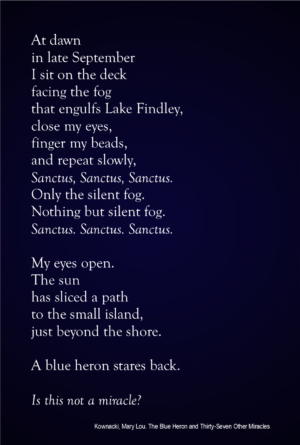
From the introduction of her book The Blue Heron and Thirty-Seven Other Miracles, Kownacki writes:
“The real miracle is not to walk either on water or in thin air, but to walk on the earth,” Thich Nhat Hanh, the Buddhist monk wrote.
But who believes him?
This is a book about trying to walk on earth, about taking steps to see every moment as a miracle, as a blessing, as a love song from our Creator. The book is also an invitation, an encouragement to find the miraculous in the ordinary events of your life. Try to imagine how different life would be if we all recognised and revelled in the present, in the common, as sacrament. Come, let’s walk together on earth. Let’s celebrate the miracles happening to us moment by moment.
Monday morning
in the inner city.
My guru,
the boom box
on the neighbor’s tenement
roof,
about five yards from my
prayer corner.
This morning
I am offered
a choice of mantras:
“Born in the USA”
or
“Like a Rolling Stone.”
Koans to wrestle with a
lifetime
from Zen masters
Bruce Springsteen and Bob Dylan.
Is this not a miracle?
She is still weeping
for the young deer
whose fresh blood
was splattered
on Interstate 80
ten miles ago.
Is this not a miracle?
O, the books I read,
the retreats I made,
the lectures I attended,
the beads that passed
my fingertips
to understand
what Saint Paul meant
when he told the
Thessalonians
to pray without ceasing.
Then
this morning
I listened
– for the first time –
to the sparrow sing.
Is this not a miracle?
If on my deathbed
a slight smile plays
upon my lips
know it was
that January walk on the bay
when we first met,
remember:
at dusk,
the light snow,
the thin ice beneath our feet,
your hand
holding my arm tightly,
the circling mist
daring us to continue
walking together
into the winter night.
And we did.
Is this not a miracle?
—
Grace,
Alan
//2023 01 15 Sunday Sermon
Kevin Needham: Make the Circle Bigger
[Isaiah 49:1-7; John 1:29-42]
//
Friends,
Last week, Benedictine Sr. Mary Lou Kownacki died at age 81. You may not have heard of her before but if you have been at CMM over the years – you would have heard me repeatedly teach her interpretation of the Beatitudes. And if you have not, then later this month when the Lectionary readings sit us down to listen to Jesus’ staggering sermon on the mount, I will reach for her interpretation again. Not only a remarkable interpreter of scripture, but a courageous doer of justice and practitioner of mercy. She humbly walked this earth holding the hand of the poor, knowing that she was in fact holding the hand of God. She lived honouring the sacredness of life with every sacred fibre of her own life.
In her 1981 book, Peace is our Calling: Contemporary Monasticism and the Peace Movement, Kownacki beautifully describes the Benedictine way of Christian life. I include some of her description below and encourage you to allow her words to “scan” over your own way of life. Listen out for the words or images or sentence that beeps at you – causing your attention to pause and focus. Hover for a moment over the spot it has touched within you and ask: Why the alert?
The Benedictine way of Christian life was not begun to do any special work. Benedictines are to be living signs that strangers can come together in Christ, care for one another, hold one another up, challenge one another to grow. Our essential ministry is community.
Obedience is a promise to be a faithful listener. … Then we work to respond with generosity and courage. Conversion is a dedication to lifelong growth. We are never fully converted; our lives are a continuing process of listening to the Voice of God, opening our hearts to the Word and growing in love. Daily we pray, “Turn our hearts of stone to hearts of flesh.” Stability is a promise to be faithful to one’s sisters as a way of faithfulness to God. We establish the lifelong human bonds so necessary for healing growth. We agree to search for God together, making our journey as honest, as loving, as human as possible.
Benedictines look at the world God has created and say: “It is good.” We affirm moderation rather than severe asceticism; transformation within society rather than withdrawal from it.
Our common prayer, called the Liturgy of the Hours or opus dei, is based on the texts of the Old and New Testaments … If we are faithful, the Word of God enters our life and disrupts it. Often it impels us to disrupt the lives of others. Always it gives peace.
We think there is great wisdom in the words of the psalmist: “Be still, and know that I am God.” We try to create an atmosphere of prayerfulness, solitude, silence and leisure in our lives so the Word of God can penetrate our hearts and take root. As we enter into solitude we approach the elusive presence of God, open our true selves, and find inner peace. We come to know that we are made in God’s image and that God is love.
The intensity of the contemplative vision draws us, as it did Jesus, “to enter compassionately into the struggle, pain and suffering of the world.” Gradually the Spirit transforms us into contemplatives, impelled to action, who see with the heart of Christ: we find the Creator in all creation; we can look on the face of any woman or man and touch our sister or brother.
Each Benedictine community … is a life with a distinctive rhythm. The community gathers for prayer to mark the coming of light and darkness, the passing of night and day. There is time given to serving others and time set aside for reading and personal prayer. Sisters come together for meals and discussions; individuals are encouraged to spend time in silence and solitude. Periods are devoted to study and hours given to play. All creation is treated with reverence, all time is seen as holy. As the days open and close, as the seasons turn and the cycles of redemption are celebrated, a whole and healing life rhythm begins to flow into time.
The creative balance of forces – if she chooses to internalize them – allows each woman to become her truest self. At the depth of her being, at the ground of her being, she discovers love.
Kownacki, Mary Lou. Peace Is Our Calling: Contemporary Monasticism and the Peace Movement
Grace, Alan
PS: If you have not heard Leonard Cohen’s song Democracy then tap the link “staggering sermon on the mount”.
//Sunday Sermon 2023 01 08
Alan Storey: Renewal is Rooted in Remembering
[Isaiah 42:1-9; Psalm 29; Acts 10:34-43; Matthew 3:13-17]
//
Friends,
Once a year over Christmas and New Year I go on an all-out gardening binge. A real bender. As with most binges there are some not so lekker consequences. Like getting up in the morning. Every year I am stiffly reminded that gardening is gym by another name. It is all lunges and squats, in the mud rather than the mirror.
My binge gardening consists mainly of pulling things out the ground. It always seems that the stuff I do not want to grow – grows obsessively. Without assistance at all – popping up here there and everywhere. Attaching to this and that and basically taking over everything in their path – including the path. Growing and going where they know they are not supposed to grow and go. All without a care in the world. Trespassing anarchists.
So, I pull them out and cut them back – hacking and chopping and digging – snipping and pruning just don’t cut it. Overwhelmed and impatient, I hire someone with a weed-eater thingy to mow the “invasives” down. But a week or so later they respond with revenge, spawning a 100 fold more. I multiply what I try to defeat. These plants demand to be respected enough to be removed at their root or not at all.
Conversely, almost everything that I want to grow, grows so s-l-o-w-l-y. Sloth-like. I wish the creepers would hurry up and creep up to provide shade, but they stubbornly refuse to stretch skyward. Why are they so slow to do what they are born to do and what their label promises they will do? Surely they can’t be afraid of heights.
And it is these plants – the ones I hope to hurry up and grow, rather than the others that attract dodgy company. Parasitic company. This then demands loads of my time and attention. Gloves-off attention. Finicky-finger attention. The worst is the exceedingly passionate and persistent parasite called dodder laurel that goes by the common and disarming name, love vine. No doubt because it clings so tightly to the host plant. Each string-like-strand curling round the stems or branches of the host must be individually removed by gently undoing their sticky twines. There is no other way to do it without harming the host. There are no short cuts. Uncurling. Unlearning. Undoing attachments. Ultimately liberating and healing.
Finally, planting never fails to feel foolish. I look at the size of the tomato seeds with suspicion. Each seed simply looks too small to carry their promised nourishment. So, every season I must fight the temptation to not sprinkle a couple of seeds into each finger-poked-bed of soil. Living in a more-is-better-world, my planting mantra becomes: One is enough. One is enough. One is enough.
I am not sure if Paul was a gardener, but I have a feeling he may have been, after all he wrote about planting with Apollos watering and God making it grow [1 Corinthians 3:6]. More to the point in the light of my own gardening experience, Paul wrote: “For I do not do the good I want, but the evil I do not want is what I do.” [Romans 7:19]. There are few words in all of literature that so acutely describe our human condition as these. I invite you to consider the truth of them in your own life. If gardening doesn’t fit, what is the metaphor you would use to describe how this plays out for you?
Grace,
Alan
//Sunday Sermon
2022 02 20 Alan Storey
The Gift and Wisdom of “Love your Enemies”
[Genesis 45:3-5a; Psalm 37:1-11, 39-40; Luke 6:27-38]
Prayer for Peace, Hope and Justice by Jacqui Couper.
//
Friends,
The Squid Game is a Netflix series that came out in September 2021. It’s been viewed in at least 94 countries by more than 142 million member households. Crazily, it totalled over 165 billion viewing hours in its first 4 weeks.
Each episode has contestants play a variation of a well-known children’s game. The first game is like red light / green light, with contestants allowed to move while a mechanical doll faces the tree, but the moment the doll turns to face the contestants, everyone must freeze.  Failure to keep dead still results in death. The contestants are eliminated by being shot. Similarly, one gets a bullet to the head for losing at marbles. A variation of tug-of-war involves the weaker team being pulled over the edge of a high platform resulting in the entire team falling to their death. The anonymous red-suited authorities apply the rules without question, while faithfully honouring their triangle, square and circle hierarchy. The 456 contestants are soon whittled down to a handful with ultimately just one left standing to collect the billions in prize money. All this is entertainment to a tiny group of VIPs.
The concept is horrifying. The violence is terrifying. The brutality is sickening.
What desperation would cause anyone to risk their life to play a series of deadly children’s games? Debt! Each contestant was deep in dept and therefore desperate enough to risk their life for the slightest chance of getting out of it.
Before we are tempted to write off Hwang Dong-hyuk, the creator of The Squid Game, as some kind of sadist, he explains: “I wanted to write a story that was an allegory or fable about modern capitalist society – something that depicts an extreme competition somewhat like the extreme competition of life.” Dong-hyuk wrote the Squid Game in 2009 but every film company turned it down saying it was “too grotesque and unrealistic”. It’s deeply troubling to note that by 2019 the same Squid Game came across as more “intriguing and realistic.” Realistic? Yes realistic. A reality exposed and deepened by Covid-19: A recent South African survey reveals that 47% of all respondents have been unable to pay debt and that 45% lost most of their income in the past six months. Globally, on the other extreme a billionaire was created every 26 hours during the Covid pandemic with the wealth of the world’s 10 richest men doubling, rising at a rate of $15,000 (R225k) per second.
What are we to call a system that allows and enables such grotesque inequality? A system that has gone rogue beyond the self-corrective reach of Adam Smith’s naive invisible hand. To follow the brutal consequences of such a system into the flesh and blood of humanity and into the soil and water of creation is to be horrified, terrified and sickened. Surely, evil is not too strong a word?
The purpose of allegory, fable or parable is to open the eyes of an otherwise blind society. To draw us out of our denial. To wake us up from our greedy and violently competitive ways. To urgently change a system lubricated by competition with one centred on compassion. A system that majors in the forgiveness of debts of our neighbours and of nations. In South Africa we do not need horrifying allegory, fable or parable. All we have to do is look outside.
With grace,
Alan
//Sunday Sermon
2202 02 13 Alan Storey
The Practice of Loving People
[Psalm 1; Luke 6:17-26]
Opening Prayer by Gilbert Lawrence
Prayer for Peace, Hope and Justice by Yvette Andrews